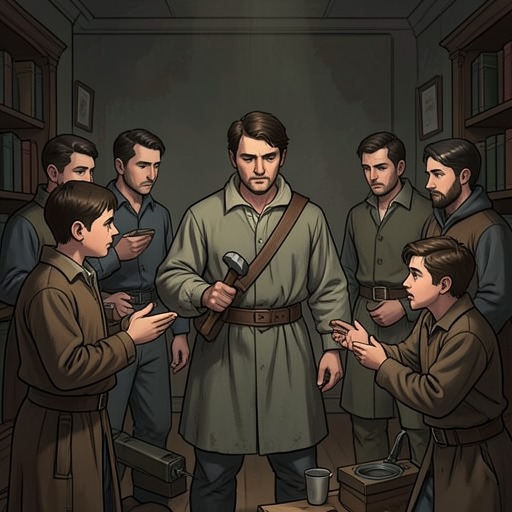
Ish Williams and The Tribe
Earth AbidesIsh Williams and The Tribe are bound by a tension between survival and renewal: the community has endured by using what the Old Times left behind, while Ish increasingly sees that endurance without learning or organization will leave its children vulnerable. His role is not that of a formal ruler, but the Tribe turns to him for ideas in moments of difficulty. His effort to make people recognize their collective predicament marks a shift from observing a changed world to trying to shape the society growing within it.
From observer to participant
After the Great Disaster, Ish had devoted himself to watching how the world changed in humanity’s absence. By the time twenty-one years had passed, he judged that the natural environment had largely adjusted, and its further changes no longer demanded close observation from day to day or month to month. The problem that now held his attention was society itself: how the survivors might adjust and reconstitute a shared life.
That change in attention also altered how Ish understood his place in the community. He could not remain only a student who watched and commented. The Tribe numbered just thirty-six, and, although Ish was not precisely its ruler, its members naturally turned to him when trouble arose. His ideas could therefore matter directly to the society around him, not merely to some distant future. The possibility of influence carried weight as well as promise: the examples of scholars who had become rulers made him wary of the personal costs of power, even as he recognized that his small community gave him unusual scope to affect its development.
The speech against scavenging
Ish’s call for change comes in his own living room, before only a few people. Yet as he begins speaking, the small gathering seems to him like an audience in a great amphitheater, as if he were addressing a nation or the world. The scale of that imagined audience enlarges the immediate complaint into a warning about the community’s future. He declares that they have waited long enough and that their way of life must change.
The substance of his warning is practical. The Tribe has continued to scavenge among supplies left by the Old Times without making or producing things for itself. Those supplies will eventually run out, whether in the present generation or in the lives of their children and grandchildren. Ish distinguishes food, which people might still obtain from cattle and rabbits, from the more complicated things on which their accustomed life depends. He presses the point through ordinary examples: what will happen when the matches are used up or spoiled, and how will people build fires then? The refrigerator they have just been discussing becomes another emblem of the gap between talking about a need and learning how to meet it.
Ish compares the Tribe’s passivity to an enchanted king who watches everything move around him but cannot act to break the spell. At first, he allows, the paralysis may have been a response to the Great Disaster and the destruction of the world people had known. But twenty-one years have passed. His complaint is not simply that the survivors have suffered or that their situation is difficult; it is that a temporary dependence has hardened into a settled habit. The gathering seems pleased and receptive, and Joey’s face lights with excitement, but the speech itself does not instantly turn agreement into action.
Independence, authority, and the family
The incident that sharpens Ish’s argument is Jack’s conduct at an important meeting. Ish initially becomes angry when Jack acts independently, but Ezra encourages him to continue speaking, asking to hear what he thinks the community ought to do and affirming that he has the ideas. Ish then recognizes that Jack is a grown man, no longer merely a boy or a son whose independence should automatically provoke resentment. The episode gives Ish a concrete example of a problem larger than material production: what holds a community together when family authority is no longer enough?
In Ish’s account, the family is the remaining fragment of an older social organization. Parents can correct a young child, but that authority ends as the child grows up. The Tribe has no established form of government that Ish can identify as a democracy, monarchy, or dictatorship, and no developed body of laws to settle what members owe one another. A person can walk away from a meeting, and even a vote to act has no reliable means of enforcement beyond public opinion. Ish sees that restoring civilization cannot mean recovering gadgets alone; it must also involve rules, laws, and ways of living among people and groups.
His speech is not a polished program. It trails into a weak ending, driven more by the emotions Jack’s action has stirred than by oratorical training or practice. That incompleteness matters: Ish can diagnose the absence of common authority more readily than he can explain how to create it. Ezra’s encouragement steadies him, but encouragement does not itself supply the institutions he is asking the Tribe to imagine. The relationship between Ish and the community is therefore neither simple command nor passive admiration. His influence depends on speaking, while the Tribe’s freedom to ignore or leave him remains part of the problem he is trying to name.
The next generation and the limits of Ish’s knowledge
A later water shortage makes the generational shift visible in practical terms. Ish, though he had been a geographer, can recall streets and intersections but cannot readily identify a nearby dependable spring or stream. The younger people know where seasonal running water, pools, and springs can be found, even though they cannot locate those places by street names. Walt instructs his father about running water in a small gully that passes beneath San Lupo Drive through a storm drain—an overlooked route through a landscape Ish still understands partly through the old map of roads.
The response to the shortage first produces consternation, then warm excitement and work. Some young people set out with dog-teams and five-gallon cans to fetch water from the nearest spring. Older members dig holes and establish outhouses. Their effort lasts several hours and produces visible results, although sustained pick-and-shovel labor is unfamiliar to them. The episode does not erase the community’s difficulties, but it shows that knowledge and initiative are not confined to Ish: the younger generation has learned to read the surroundings in ways he has not.
Ish’s relationship with The Tribe thus contains both the urgency of his warning and a measure of humility. He wants the survivors to become makers and organizers rather than remain scavengers of the Old Times, yet the water episode shows adaptation already arising outside his own expertise. His significance lies partly in recognizing that survival requires more than inherited supplies, and partly in confronting the fact that the society’s future cannot be built by his authority alone. The Tribe must turn concern into shared knowledge, sustained work, and forms of cooperation strong enough to outlast the habits that carried it through the first years.